AI for business: safe, private and practical
From AI chatbots to Local AI and private LLMs: we help organisations use AI both practically and safely, with control over data, privacy and compliance.
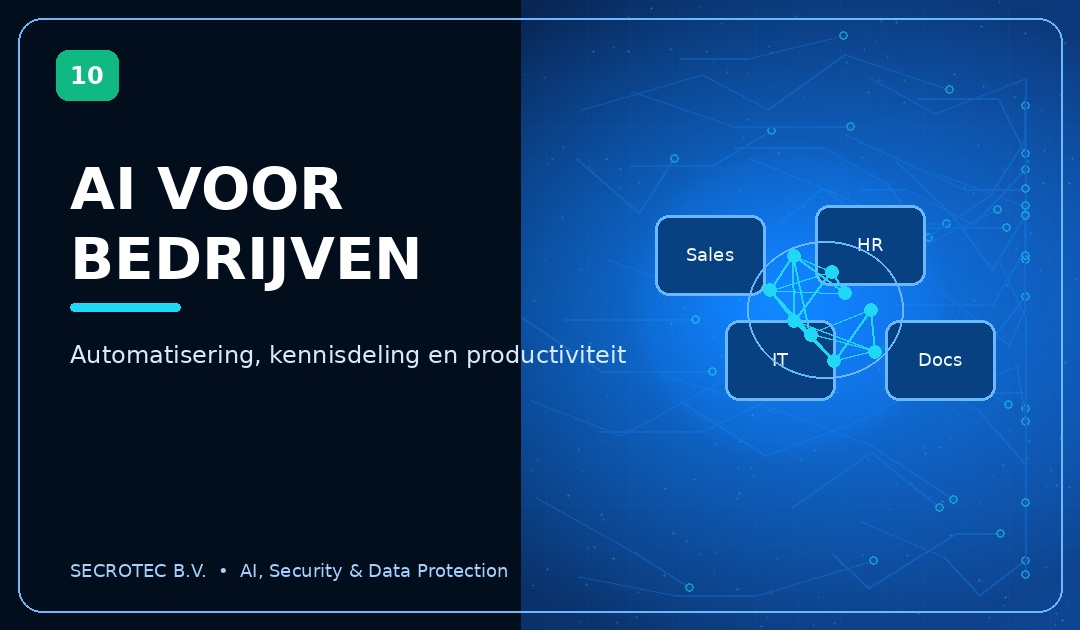
AI delivers a great deal for businesses, but only when data, privacy and manageability are in order. We help organisations use AI both practically and safely: from an AI chatbot on your own knowledge to Local AI and a private LLM within your own environment, with attention to security, governance and compliance.
What we do with AI
- AI chatbots for customer service, support and internal knowledge.
- Local AI & private LLM within your own server or private cloud.
- LoRA/QLoRA fine-tuning on your company knowledge and terminology.
- RAG solutions that back up answers with your own sources.
- AI security & governance — policy, risks and safe implementation.
Our AI approach in 7 steps
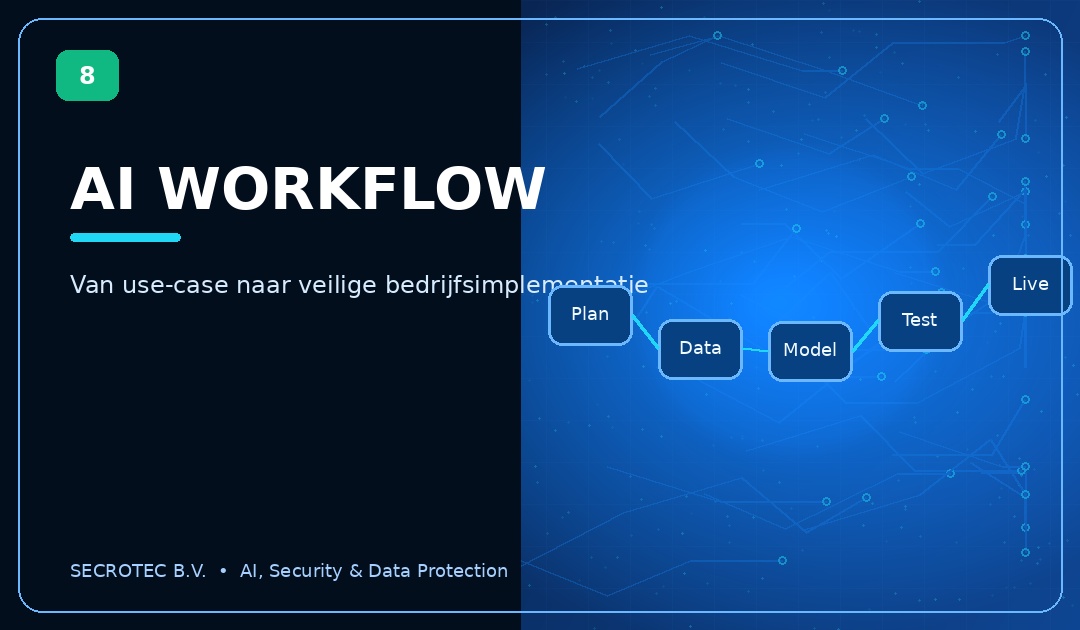
- Intake & goal setting — which processes can AI improve?
- Data & risk analysis — which data, how sensitive, which measures?
- Choosing the AI solution — cloud, local, private LLM, chatbot, RAG or fine-tuning.
- Building a prototype — testable in practice.
- Security & compliance review — data breaches, prompt injection, access, logging.
- Training & adoption — employees learn to work safely and effectively.
- Monitoring & improvement — measuring quality, errors and costs, and adjusting.
Cloud AI or local/offline AI?
The right choice depends on data, risks, costs and use scenarios. A hybrid approach is often sensible: cloud AI for general tasks, local/private AI for sensitive processes.
| Topic | Cloud AI | Local / offline AI |
|---|---|---|
| Quick to start | Very fast | More preparation |
| Costs | Subscription / usage | Investment in hardware |
| Privacy | Depends on the provider | More control in your own environment |
| Sensitive data | Only with proper agreements | Often better suited |
| Control over the model | More limited | Greater |
| Management | Less technical | More technical management |
| Best for | Fast, general tasks | Confidential data & bespoke work |
AI security, governance & compliance
AI systems deserve the same discipline as other systems: access management, logging, data classification, prompt security, output validation and supplier assessment. Include AI risks in your ISMS (ISO 27001) and align with privacy (GDPR). Recognised frameworks: NIST AI RMF, the OWASP Top 10 for LLM applications and the EU AI Act.
NIST AI Risk Management Framework (official source).
Frequently asked questions
Short, direct answers to the most common questions.
Local AI means that AI models run within your own environment — on your own server, GPU workstation or private cloud — rather than entirely in an external cloud service. This gives you more control over data, access, logging and processing, which is attractive for organisations with confidential documents or customer data.
A private LLM is a language model set up specifically for your organisation, often with retrieval augmented generation (RAG) and/or fine-tuning on your own sources. The aim is for employees to get reliable, consistent answers faster, based on protected company knowledge, without making that knowledge unnecessarily public.
Both are efficient fine-tuning techniques for adapting an existing AI model to specific knowledge without fully retraining it. QLoRA adds quantisation, which makes fine-tuning possible with less memory and lower infrastructure costs. This lets you tailor a model to your terminology and processes.
That depends on your goals. Cloud AI is fast and scalable and suited to general tasks. Local or offline AI offers more control and privacy and is attractive for sensitive data or bespoke work. Many organisations choose a hybrid approach: cloud for general tasks, local/private AI for confidential processes.
AI can be used safely, provided there are clear agreements and measures: data classification, access management, logging, prompt security, output control and supplier assessment. Decide upfront which data may and may not go into AI tools, and include AI risks in your information security policy.
With an AI use policy, training, approved tools and, where possible, technical restrictions. Make it concrete which data may not go into external AI tools and offer a safe, approved alternative — for example a private or local AI solution for confidential information.
Yes, in a supporting role. AI can help with document analysis, making policy and risks clearer, and audit preparation. The assessment, decision-making and responsibility remain with skilled people; AI is a tool, not a replacement for the auditor.
Start small: choose one concrete use case with clear goals, limited and non-sensitive data, solid security rules and measurable results. Build a pilot, train employees and then expand in a controlled way. This avoids risks and builds demonstrable value.
Use AI safely within your organisation?
Book a no-obligation AI consultation — together we look at what fits your data, risks and goals.